Last updated: November 13, 2026 · By Wander Cambodia
 By Sophea Khim · Host & Editor, Wander Cambodia
Kampong Thom is the stop most travellers sleep through on the bus between Phnom Penh and Siem Reap — and it holds one of the most important ancient sites in Cambodia. Sambor Prei Kuk, the 7th-century Chenla capital of Isanapura and a UNESCO World Heritage Site since 2017, is a forest of brick temple towers older than Angkor by two centuries, visited by a fraction of Angkor's crowds. Add a lively provincial town on the Stung Saen river, the sacred hill of Phnom Santuk, and some of the prettiest rice country on National Road 6, and Kampong Thom earns an overnight — or at minimum a proper half-day — on any trip that passes through it.
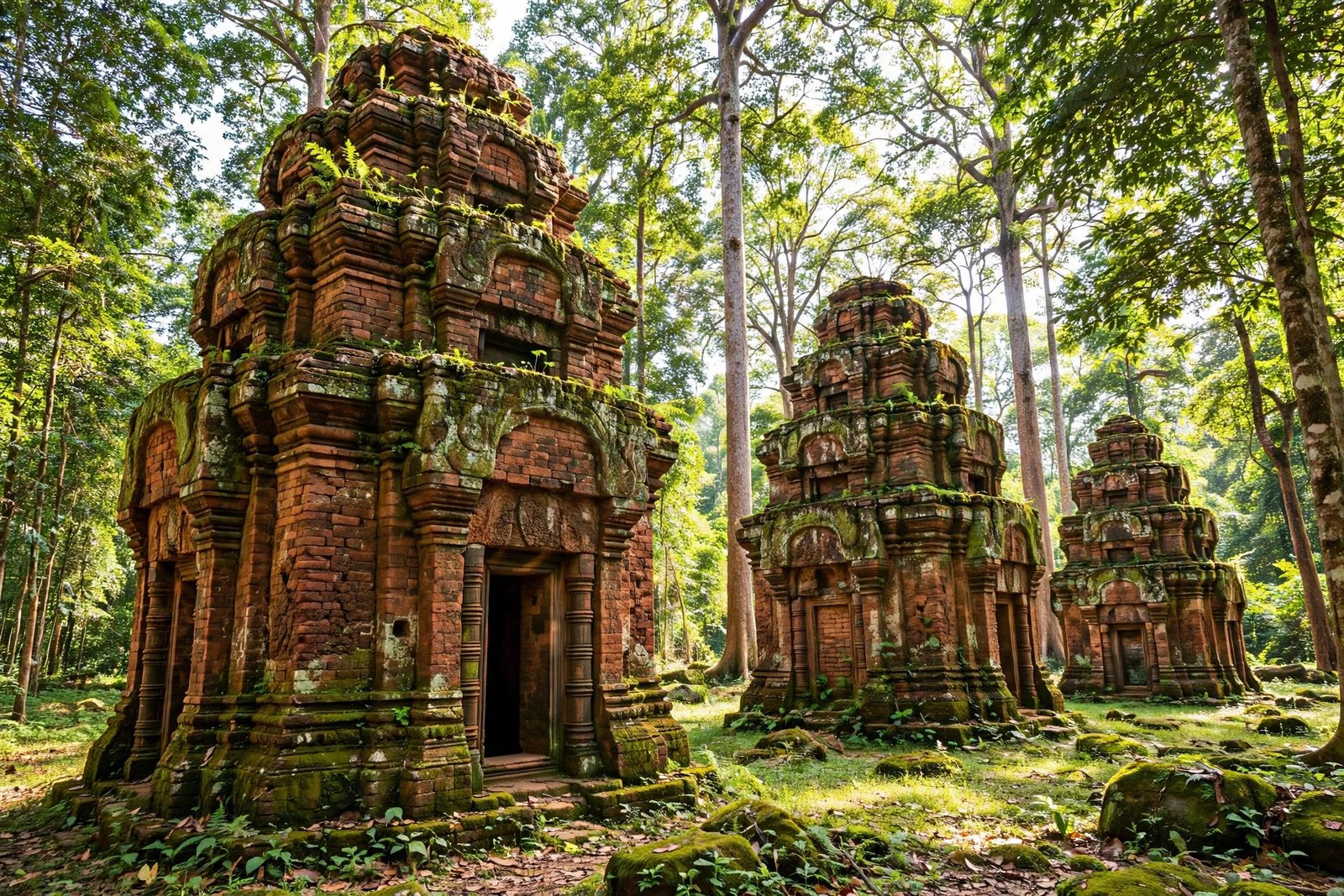
Around 30km northeast of town, Sambor Prei Kuk spreads through shaded forest: more than a hundred brick structures from the Chenla kingdom, built mainly in the 7th century under King Isanavarman I, whose capital Isanapura stood here. The three main groups — Prasat Sambor (north), Prasat Tor (central, with its lion sculptures) and Prasat Yeay Poan (south) — show the brickwork, carved lintels and octagonal towers that Angkor's builders later inherited. Because the temples sit in forest rather than on a cleared plain, the visit feels like discovery: roots over doorways, birdsong, and very few other visitors. Allow two to three hours, hire one of the local community guides at the entrance if you want the carvings read properly, and go early before the midday heat. Foreign-visitor entry has been around $10 at recent checks — confirm the current fee at the gate, and keep small cash for it.
South of town, Phnom Santuk is one of Cambodia's most sacred hills: a long stair climb (around 980 steps by the usual count) past monkeys and shrines to a summit wat with reclining Buddhas carved into the rock and views across the flooded plains. Go early or late in the day and carry water. In town, the Stung Saen riverfront is the evening centre — a market, food stalls and a bridge lit at night — and the old French-era governor's residence and the riverside stupa give a gentle hour's walk. Kampong Thom is also a working rice and cashew town; the central market is the real thing, not a tourist version.
Kampong Thom sits on National Road 6 roughly midway between the capitals of the road: about 170km from Phnom Penh (typically 2.5–3.5 hours) and about 145km from Siem Reap (typically 2–3 hours), with buses and minivans in both directions all day — the full route comparisons are in our Phnom Penh to Siem Reap guide, and every through-bus can set you down here if you ask when booking. Coming from the east, Kampong Cham is the natural pairing. Around town, tuk-tuks handle the Santuk trip, and a hired tuk-tuk or car is the practical way to do Sambor Prei Kuk without rushing.
Three good shapes: (1) The overnight break — split the Phnom Penh–Siem Reap road day, sleep here, do Sambor Prei Kuk at dawn, and arrive in Siem Reap by lunch, rested, for the Angkor days ahead. (2) The history-first route — Phnom Penh, Kampong Thom, then Angkor, so Cambodia's story runs in chronological order: Chenla first, Angkor second; the contrast makes both clearer. (3) The eastern loop — Kampong Cham, Kampong Thom, then north or back to the capital, matching our 14-day itinerary at a slower gear. One night is enough for most people; two if Santuk and a slow riverfront evening appeal. Rooms are simple and good value — this is a provincial town, so expect clean and friendly rather than boutique, and eat where the market crowds eat.
Bring small riel and dollars in cash — card acceptance is thinner than in Siem Reap (see money in Cambodia). The forest temples reward the same kit as Angkor: water, a hat, repellent in the green season. In the wettest months the Sambor Prei Kuk access road can be muddy after heavy rain; an early start and a patient driver solve it. If you are travelling in September or October, our month guides — September is the peak — explain the rain pattern that shapes days here. However you fit it in, do not let the bus window be your only view of the province that held Cambodia's capital before Angkor existed.
Kampong Thom also works as a stepping stone north: from here the road continues toward Koh Ker and on to Preah Vihear, the two great temple sites between the capital road and the Dangrek mountains.
Cambodia’s capitals stack in layers. After Sambor Prei Kuk and Angkor came Oudong, the seat of the kings from the 1600s until 1866 — an easy half-day trip from Phnom Penh, with the royal stupas still standing on the hill.
Yes — for Sambor Prei Kuk alone. The 7th-century Chenla capital of Isanapura, a UNESCO World Heritage Site since 2017, holds more than a hundred brick temples older than Angkor, in shaded forest with very few visitors. With Phnom Santuk and a pleasant riverfront town, it earns an overnight on the Phnom Penh–Siem Reap road, or a half-day stop at minimum.
Kampong Thom sits on National Road 6 about 170km from Phnom Penh (typically 2.5–3.5 hours by bus or minivan) and about 145km from Siem Reap (typically 2–3 hours). Through-buses between Phnom Penh and Siem Reap can set you down in Kampong Thom if you ask when booking.
Two to three hours covers the three main temple groups at a comfortable pace, more with a local guide reading the carvings. Go early for cooler forest shade. Foreign-visitor entry has been around $10 at recent checks — confirm the current fee at the gate and carry small cash.
One short email a week with what actually changed on the ground — no fluff, no spam.
Free forever · One email a week · Unsubscribe anytime
Visa rule changes, the best travel deals we find, and new guides — once a week, no spam.
Free forever · Unsubscribe anytime
 Wander Cambodia