Last updated: November 18, 2026 · By Wander Cambodia
 By Sophea Khim · Host & Editor, Wander Cambodia
For about a decade in the 10th century, Angkor was not the capital of the Khmer Empire. King Jayavarman IV moved the court roughly 120km northeast into the forest and built a new capital — Koh Ker — with a state temple that broke every rule of Khmer design: Prasat Thom, a seven-tier stepped pyramid about 36 metres high, the closest thing Southeast Asia has to a Maya temple. Then the court moved back to Angkor, and the jungle took the city for a thousand years. UNESCO inscribed Koh Ker in September 2023. It is still, even now, one of the quietest major temple sites in Cambodia.
Most Khmer temple-mountains hide their steps inside galleries and terraces. Prasat Thom does the opposite: seven plain, massive tiers stacked in the open, climbing out of the trees. A wooden staircase against its face now lets you climb to the top, where the remains of a huge shrine once held one of the largest lingas in the empire. The view from the summit is the point — forest canopy in every direction, with no other monument in sight. The misconception is that Koh Ker is a warm-up act for Angkor. Stand on top of the pyramid at 8am with the site to yourself and it does not feel like a warm-up for anything.
The pyramid is the centrepiece of a complex arranged on a grand scale: a vast baray (the Rahal, now dry and partly forested), causeways, and Prasat Krahom, the red sandstone tower near the entrance whose brick-red stone gives it its name. Everything here is oversized — Jayavarman IV was a usurper or a rival king, depending on whose inscriptions you believe, and he built like a man making an argument.
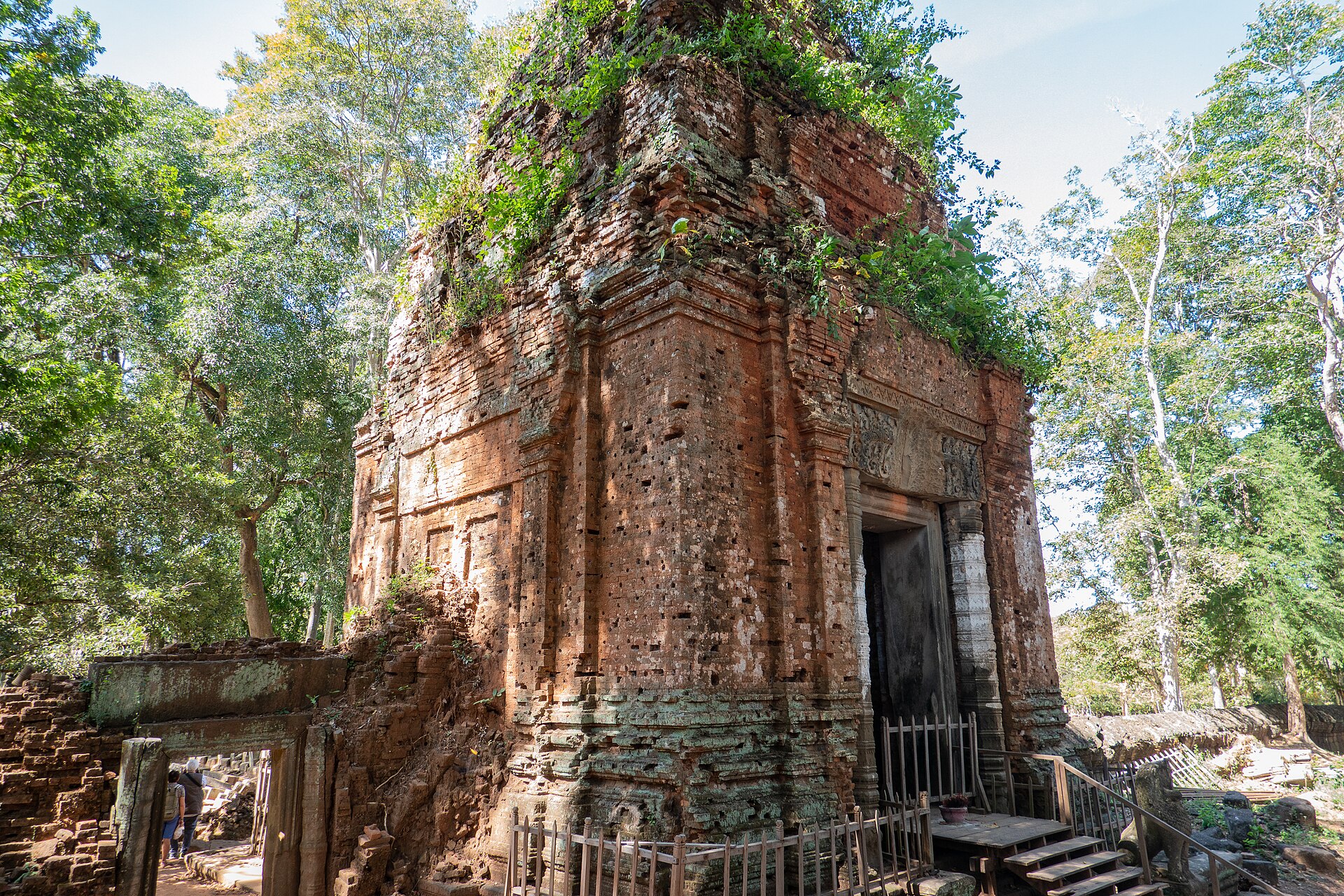
The circuit road loops past the temples most worth your time. Prasat Pram is the photograph: five brick towers, several of them gripped by the roots of strangler figs, in a clearing that feels properly lost. Prasat Neang Khmau, the "black lady" temple, is dark laterite-blackened brick with fine carving still on its lintels. A run of smaller shrines — Prasat Balang, Prasat Thneng and others — housed enormous carved lingas, some still in place, a reminder that this capital was built around Shiva worship on an imperial budget. Our hero photograph above is one of the brick towers on this circuit: red brick, forest pressing in on every side, which is the honest texture of the whole site.
Set expectations the right way: Koh Ker is not manicured. Paths are forest tracks, some temples are little more than elegant rubble, and that is the appeal. If Angkor is a museum, Koh Ker is a discovery. Travellers who have done Siem Reap and Angkor and want the other end of the spectrum — remote, shaded, uncrowded — are exactly who this day trip is for.
Koh Ker is about 2.5 hours by road from Siem Reap, paved the whole way. Hire a car and driver or join a small-group tour; there is no practical public transport. The site has its own ticket, separate from the Angkor Pass — carry small cash (see money in Cambodia) and confirm the fee at the entrance. Start early: the pyramid climb in midday heat is a grind, and the light in the forest temples is best before 10am.
Two combinations make sense. The standard day adds Beng Mealea, the great ruined temple in the jungle southeast of Koh Ker, on the way back to Siem Reap — two very different flavours of lost temple in one long day. The bigger loop continues north from Koh Ker to Preah Vihear, the cliff-top temple on the Dangrek escarpment, returning to Siem Reap in the evening or staying overnight near Sra Em. Either way, bring water and food: options at the site are a handful of stalls at the entrance, nothing inside the circuit. The point is the trade Koh Ker offers — a longer drive than Angkor, in exchange for a capital city you share with a handful of people. On the current evidence, that trade is still heavily in the visitor's favour.
On the same road home, Beng Mealea — the other great unrestored temple east of Angkor — makes the natural second half of the day: Koh Ker for the pyramid, Beng Mealea for the collapse.
A seven-tier pyramid. Prasat Thom, the state temple of King Jayavarman IV, rises about 36 metres in stepped tiers unlike anything else in Khmer architecture. Around it, dozens of brick and sandstone temples from Koh Ker's brief decade as the Khmer capital (roughly 928–944) stand scattered through forest about 120km northeast of Siem Reap.
By road — about 2.5 hours each way. There is no useful public transport, so hire a car and driver for the day or join a small-group tour. The road is paved the whole way. Most visitors combine Koh Ker with Beng Mealea on the return leg, or continue north to Preah Vihear.
No. Koh Ker has its own entry ticket, sold at the site entrance — it is not part of the Angkor Archaeological Park pass. Carry small cash and confirm the current fee at the gate. UNESCO inscribed Koh Ker as a World Heritage Site in September 2023.
Half a day covers the main circuit: Prasat Thom and its pyramid, Prasat Pram, Prasat Neang Khmau and the linga shrines. Temple completists can fill a full day — more than 180 structures have been identified across the wider site, though only a fraction are cleared and visitable.
A wooden staircase built against the pyramid lets visitors climb to the summit platform, where a ruined shrine stands and the view runs over the forest canopy. The climb is steep and exposed — take it slowly, carry water, and skip it in the midday heat if heights or heat are a problem.
One short email a week with what actually changed on the ground — no fluff, no spam.
Free forever · One email a week · Unsubscribe anytime
Visa rule changes, the best travel deals we find, and new guides — once a week, no spam.
Free forever · Unsubscribe anytime
 Wander Cambodia