Last updated: November 19, 2026 · By Wander Cambodia
 By Sophea Khim · Host & Editor, Wander Cambodia
Everybody who goes to Angkor sees Ta Prohm, the temple with the famous tree roots, and fights a crowd for the photograph. About 40km east of the main group stands the temple Ta Prohm is a preview of: Beng Mealea, a complex on the scale of Angkor Wat itself, left almost exactly as it fell. Galleries lie in waist-high heaps. Trees grow out of doorways. A wooden walkway, built so visitors can cross the wreckage without climbing on it, threads through the middle. It is the least restored major temple in the Angkor region, and for a lot of travellers it ends up the favourite.
Beng Mealea was built in the early 12th century, in the same style and almost certainly the same reign — Suryavarman II — as Angkor Wat. The layout gives it away: a vast moat, long causeways, cruciform terraces guarded by five-headed naga balustrades, library buildings flanking the approach, and a central sanctuary on the same plan as its famous cousin. It was a Hindu temple, dedicated to Vishnu, though some carvings carry Buddhist motifs added later.
Here is the odd part: nobody knows exactly who built it or why, because no foundation inscription has ever been found. For a temple this size, that silence is remarkable — Angkorian kings usually carved their names into everything. What is documented is its second life: it stood on the ancient royal highway running east from Angkor toward Koh Ker and Preah Khan Kompong Svay, which is why a complex this large sits out here in the forest at all. Cambodia put Beng Mealea on UNESCO's Tentative List in March 2020; it is protected, ticketed and staffed, but deliberately not restored into tidiness.
You arrive at a small ticket area, cross the moat, and the scale lands first: the enclosure is enormous, and most of it is rubble under trees. The wooden walkway is the spine of the visit. It carries you over collapsed galleries and through doorways that would otherwise need scrambling, and it keeps your feet off stones that include carved lintels lying where they dropped — look down as you go, because some of the finest carving at Beng Mealea is on the ground, including a fallen lintel showing the Churning of the Sea of Milk.
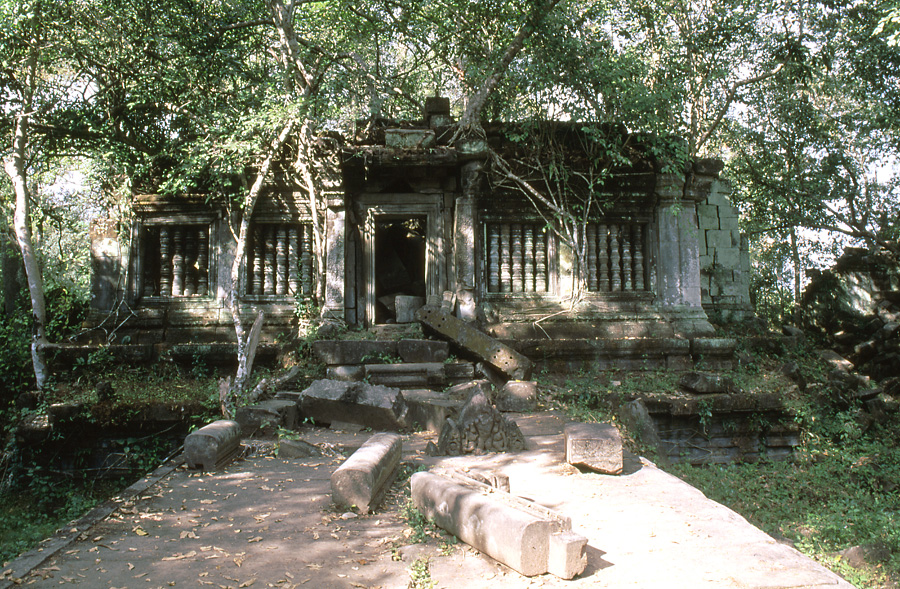
The misconception is that an unrestored temple means there is nothing to see. The point is the opposite. At restored temples you read the building; here you read the collapse — how a gallery roof comes down in layers, how a strangler fig prises a wall apart over centuries, how the jungle reclaims sandstone at a predictable speed. Our hero photograph above is a typical Beng Mealea view: a small shrine building still standing in a clearing, fallen column drums on the causeway in front of it, forest pressing in on every side. Sections off the walkway are roped or simply impassable, and that is a safety matter, not a challenge: uncleared areas of old temples can hide unstable stone and, in remote parts of this region, old ordnance. Stay on the walkway and the marked paths.
Beng Mealea is not covered by the Angkor Pass. It has its own one-day ticket — US$10 at the time of writing, the same separate-ticket family as Koh Ker at US$15 — sold at the site. Carry cash in small notes (see money in Cambodia for how the dollars-and-riel mix works) and confirm the price at the booth, because ticket bundling in the region changes.
The standard way to do Beng Mealea is as half of a long day: drive out past it to Koh Ker, the jungle capital with the seven-tier pyramid, then stop at Beng Mealea on the way back to Siem Reap — or the same pair in the other order. Start early. The walkway is shaded for much of its length, which makes Beng Mealea one of the more forgiving temples in the midday heat, but the drive is long and the light in the ruins is best before 10am. Give the temple itself an hour to an hour and a half. The point is the trade: an extra hour on the road buys you the Angkor-era temple that mass tourism, for now, mostly drives past.
A very large, largely unrestored 12th-century temple about 40km east of the main Angkor group. Built in the same style and period as Angkor Wat, it was left where it fell: galleries collapsed, trees growing through the stonework, and a wooden walkway now threading visitors through the ruin. Its name is usually translated as “lotus pond”.
No. Beng Mealea has its own one-day ticket, sold separately — US$10 at the time of writing. It is not part of the Angkor Pass, and neither is nearby Koh Ker (US$15). Carry cash and check the current price when you buy, because what is bundled changes.
By road — roughly 65–70km, about 1 to 1.5 hours each way by car or tuk-tuk. There is no useful public transport. Most visitors hire a driver for the day and combine Beng Mealea with Koh Ker, which lies further along the same general route northeast of Siem Reap.
About an hour to an hour and a half covers the walkway circuit and the main galleries at a sensible pace. It is a single-temple visit, not a full complex day — the time cost is the drive, which is why combining it with Koh Ker makes sense.
Yes — it is a different experience. Ta Prohm is a maintained ruin inside a busy park. Beng Mealea is bigger, quieter and far less restored: whole galleries lie in heaps and the walkway picks a path over and through them. If the jungle-temple mood is what you came for, Beng Mealea is the strongest version of it.
One short email a week with what actually changed on the ground — no fluff, no spam.
Free forever · One email a week · Unsubscribe anytime
Visa rule changes, the best travel deals we find, and new guides — once a week, no spam.
Free forever · Unsubscribe anytime
 Wander Cambodia