Last updated: November 23, 2026 · By Wander Cambodia
 By Sophea Khim · Host & Editor, Wander Cambodia
Every capital leaves something behind when it moves. Phnom Penh got the palace, the ministries and the traffic. Oudong kept the kings. For roughly two and a half centuries — from the early 1600s until the court moved south in 1866 — this hill town on National Road 5 was the seat of Cambodia's monarchy, and the royal stupas still stand along the ridge of Phnom Oudong, visible for miles across the flat country north of the capital. It is the best half-day trip out of Phnom Penh, and the least packaged one.
Start with what the hill actually is, because the misconception is that Oudong is a ruin. It is not Angkor. There is no vast abandoned city to wander. What there is: a long wooded ridge with two humps, a stairway of just over 500 steps, and a line of stupas and shrines along the top — the burial place of Khmer kings, still tended, still prayed at, still busy with Cambodian families on weekends. The history is real, but the site is alive, and that changes how you should visit: dress for a temple, not a trek, and expect to share the summit with picnics.
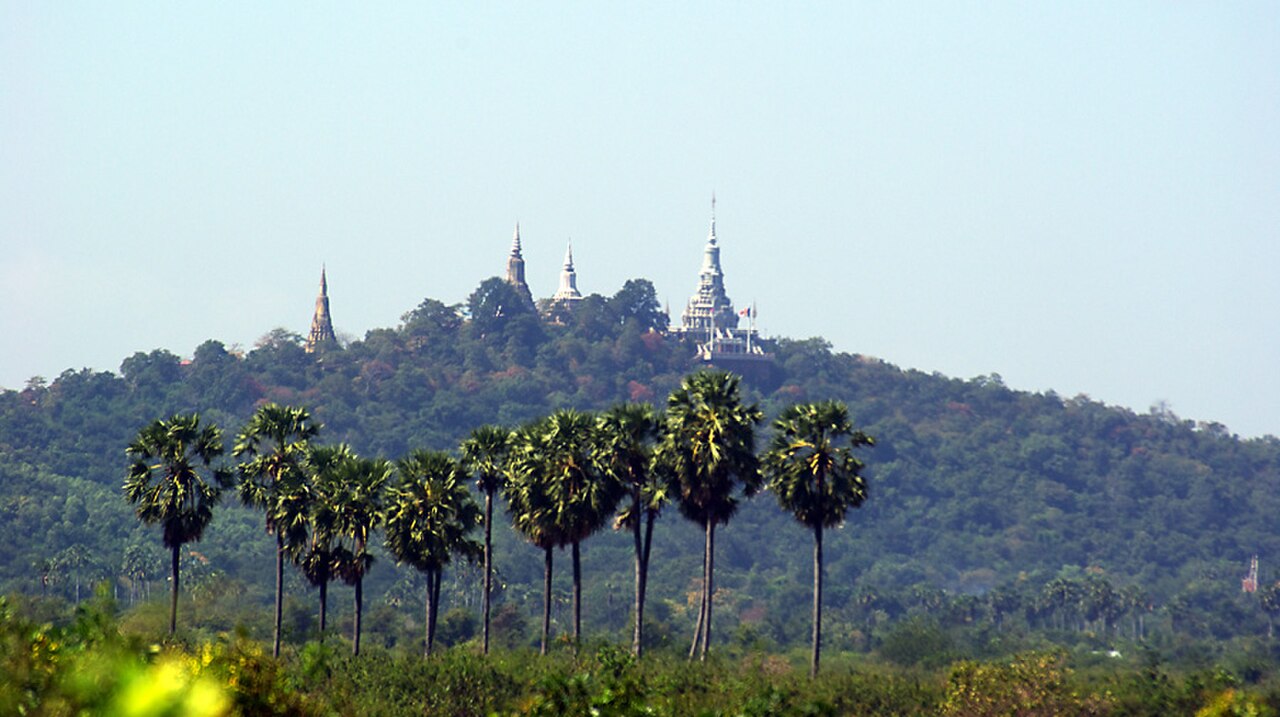
The climb rewards you in layers. Partway up, look back: the plain below runs flat to the horizon, patched with rice fields and sugar palms, with the Tonle Sap river system glinting to the west in the wet season. On the ridge itself, the stupas hold the ashes of kings of the Oudong era — the grandest, a tall grey-white stupa on the northern hump, is the one in our photograph, seen from the plain. Allow time to walk the full ridge rather than climbing to the first shrine and turning back; the quieter northern end is where the scale of the old capital lands. Below the main hill sits a large modern vihara and, at the base, one of the country's biggest meditation centres — the nuns and lay practitioners in white you will see around the hill belong to it.
One honest warning, because every Oudong report should carry it: monkeys live on the hill and they are professionals. Keep snacks inside your bag, do not feed them however much the children around you are doing it, and hold onto sunglasses and loose bottles on the stairway. It is a small tax on an otherwise gentle visit.
Half the Oudong experience happens at ground level. The road at the foot of the hill fills with stalls selling what Cambodian day-trippers actually come for: grilled chicken and fish, palm sugar and palm juice, fruit, and rows of woven hammock shelters where families rent a mat, order food, and settle in for the afternoon. Join in rather than spectating — a grilled chicken, rice and a hammock for an hour is the correct Oudong lunch, and it costs local prices because the customers are local. If you are visiting on a weekday the scene is calmer; on Sundays and public holidays it is a festival, which is either the point or the reason to pick another day, depending on your temperament.
Oudong sits about 40km northwest of Phnom Penh on National Road 5, the Kampong Chhnang road. The standard move is a hired tuk-tuk or car for the half day — agree one total price that includes the driver waiting, before you leave the city, and start early: the stairway has little shade and the hill is at its best before ten. Coming back into the city in the early afternoon leaves the rest of the day free — our Phnom Penh guide covers what to do with it. Budget travellers can ride a Kampong Chhnang-bound bus or shared taxi and ask for the Oudong turn-off, then take a moto the last stretch to the hill; it works, but the saving is modest against the convenience of a driver who waits.
Go early. The stairway faces the day's heat with little shade, the light on the stupas is best in the morning, and an early start puts you back in Phnom Penh for lunch if you want it. Dress as you would for any Cambodian temple — shoulders and knees covered — because the ridge is an active religious site, and expect a small donation or parking contribution at the base rather than a formal ticket gate; carry small riel notes for it, for water on the climb, and for the stalls. Weekdays are the calm version of Oudong. Sundays and the big festivals — Pchum Ben above all, when families honour their ancestors at exactly these kinds of stupas — turn the hill into a national picnic, which is wonderful to witness and slower to climb. Photographers should know the classic shot is not from the top at all: it is our hero view, the stupas on their green hill across the sugar palms, taken from the plain on the road in.
The point of Oudong is proportion. Cambodia's story is usually told through Angkor at one end and the capital's museums at the other, and the middle — the centuries when this hill was the kingdom — gets skipped. Half a day, 500 steps and a picnic lunch fix that. Go early, climb slowly, eat at the base, and you will understand the map of modern Cambodia better than another day in the city would teach you. Travellers routing north afterwards can continue up the same road toward Kampong Cham country or across to Kampong Thom and Sambor Prei Kuk, the capital that came before Angkor — Cambodia stacks its capitals, and Oudong is the layer closest to the surface.
Continuing up National Road 5, the next town worth a real stop is Kampong Chhnang, the pottery town — Ondong Rossey village, floating villages on the river, and countryside temples of the same quiet kind as this one.
The former capital of Cambodia. From the early 1600s until 1866, when King Norodom moved the court to Phnom Penh, Oudong was the royal city — which is why a modest hill about 40km northwest of the modern capital carries the royal stupas of several kings. Today it is a pilgrimage site, a picnic hill, and the easiest history day trip out of Phnom Penh.
About 40km up National Road 5 — roughly an hour to an hour and a half depending on traffic leaving the city. Most visitors hire a tuk-tuk or car for the half day (agree the total price, including waiting, before you set off), or ride a local bus or shared taxi toward Kampong Chhnang and get out at the Oudong turn-off. There is no direct tourist bus.
The main stairway up Phnom Oudong is commonly counted at just over 500 steps. It is a steady climb rather than a hard one — go early, carry water, and take the views over the Tonle Sap floodplain as your rest stops. A second, gentler path serves the other ridge.
Half a day is the honest size: an hour each way on the road, an hour to ninety minutes on the hill itself, and time at the base for the markets and food stalls. It pairs naturally with a slow afternoon back in Phnom Penh rather than with another sight.
Yes — if what you want is Cambodian history that is still in daily use. Cambodian families come here to picnic, make offerings and visit the stupas of their kings; you are a guest at a living site, not a visitor at a museum. Skip it only if your Phnom Penh time is a single day, when the city's own sights come first.
One short email a week with what actually changed on the ground — no fluff, no spam.
Free forever · One email a week · Unsubscribe anytime
Visa rule changes, the best travel deals we find, and new guides — once a week, no spam.
Free forever · Unsubscribe anytime
 Wander Cambodia