Last updated: November 20, 2026 · By Wander Cambodia
 By Sophea Khim · Host & Editor, Wander Cambodia
Most lakes sit still. The Tonle Sap breathes. Every year this lake in the middle of Cambodia grows to roughly six times its dry-season size, swallows its own shoreline forest, then shrinks back again — because the river that drains it flows backwards for half the year. It is the largest freshwater lake in Southeast Asia, one of the most productive inland fisheries on the planet, and the water system Angkor was built to exploit. If you visit one landscape in Cambodia beyond the temples, this is the one.
Start with the mechanism, because everything else follows from it. The Tonle Sap lake connects to the Mekong at Phnom Penh by the Tonle Sap River, about 120km long. In the dry season the lake drains down that river into the Mekong, the normal direction. Then the monsoon arrives, the Mekong swells with rain and Himalayan snowmelt, and its level at the junction rises above the lake's. The flow reverses. For months, Mekong water pours into the lake instead of out of it.
The numbers are the point. The lake goes from roughly 2,500 square kilometres and about a metre deep to something like 16,000 square kilometres and up to nine or ten metres deep — an area the size of a small country appearing and disappearing on schedule. The flooded forest around the shore goes underwater, fish move into the trees to feed and spawn, and when the river turns again in the dry season it carries an enormous fish harvest back out. That pulse is why the lake has historically produced a huge share of Cambodia's freshwater fish catch, and why well over a million people live on, in and around it. Phnom Penh celebrates the river's turn back at the Water Festival, which only makes sense once you know what is being celebrated.
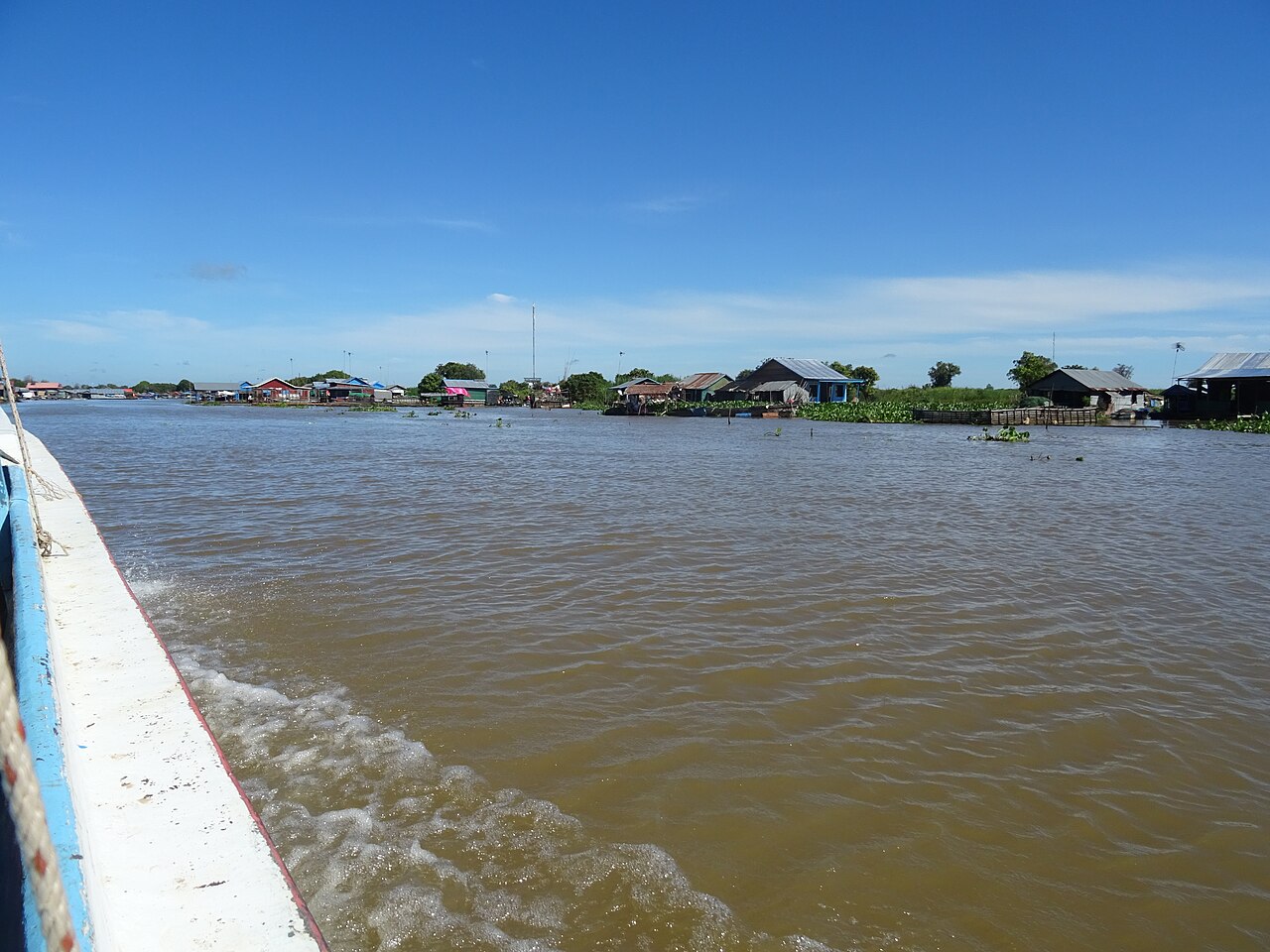
People have adapted to the flood pulse in two ways, and you can visit both. Stilt villages — Kampong Phluk and the larger, quieter Kampong Khleang — stand on poles six to nine metres tall: dry-season streets, wet-season islands, the same houses. Floating villages, like Chong Kneas and Mechrey nearer Siem Reap, skip the poles entirely: houses on barrels and boat hulls that rise and fall with the lake and get towed to new anchorages as the shoreline moves.
The honest warning belongs here, because the lake's visitor economy has a known weak point. There is no single official ticket for the villages: boat fees, community fees and add-ons are set locally, they change, and at the busiest gateway, Chong Kneas, travellers have complained for years about prices quoted one way and charged another. The fix is boring and it works: before you board anything, state the total back — boat, village entry, flooded-forest canoe, everything — and agree it. Kampong Phluk and Kampong Khleang run calmer operations, which is one reason our village guide points most readers there first. The travellers who leave annoyed are rarely annoyed at the villages. They are annoyed at a price that was never made plain, and that is avoidable in about thirty seconds.
The misconception is that there is a right season and a wasted one. There are two visits. From about September to January the lake is up: you boat through villages standing deep in water, paddle the flooded forest in a small canoe, and the whole system reads as one vast inland sea — this is the classic trip, and it pairs naturally with a high-water stay in Siem Reap. From about March to May the lake retreats, channels narrow, some boat routes stop, and the stilt villages stand exposed on their forest of poles — less postcard, more revealing about how the place actually works. The shoulder months sit between the two and vary year to year, because the flood follows the Mekong, not the calendar.
One more connection worth making while you are here: the lake is not separate from Angkor, it is half of why Angkor exists. The empire's reservoirs and canals managed dry-season water, but the Tonle Sap's reliable fish protein and flood-fed rice land fed the city at scale. Standing on a boat watching a village school float past, you are looking at the same system, still running. The slow boat between Siem Reap and Phnom Penh crosses the lake in high water — we cover it in the Phnom Penh to Siem Reap route guide — but the villages deserve their own half day, not a view from a ferry window. The point is simple: the temples show you what the empire built. The Tonle Sap shows you what it was built on.
Southeast Asia's largest freshwater lake, in central Cambodia — and one of the strangest lakes on earth. In the dry season it covers roughly 2,500 square kilometres. In the rainy season the Tonle Sap River reverses direction, Mekong water pours in, and the lake swells to around 16,000 square kilometres, flooding the forest around it. UNESCO recognised it as a biosphere reserve in 1997.
Pressure. When the Mekong rises with monsoon rain and snowmelt, its water level at Phnom Penh climbs above the lake's, and water pushes up the Tonle Sap River into the lake instead of draining out of it. When the Mekong falls in the dry season, the flow reverses again and the lake drains. The Water Festival in Phnom Penh marks the river turning back.
From Siem Reap, which sits just south of the lake. The main gateways are the boat villages: Kampong Phluk (stilt houses), Kampong Khleang (larger, further, less visited), Chong Kneas (closest, and the one with the worst reputation for inflated fees) and Mechrey. Most visits are a half day by road plus a boat through the village and, in high water, the flooded forest.
For the classic flooded-lake experience, roughly September to January, when the water is high and villages float or stand deep in it. In the dry months (about March to May) the lake shrinks hard, boat channels get shallow, and the visit becomes a stilt-village walk instead. Neither is fake — they are two different lakes wearing one name.
Yes, if you go in with the right frame: this is a working fishing lake that supports well over a million people, not a scenic attraction built for visitors. Go for the scale, the reversed river, and villages that live with a six-metre rise and fall of water. Confirm every fee in total before you board a boat — the lake's one consistent complaint is pricing that was never stated plainly.
One short email a week with what actually changed on the ground — no fluff, no spam.
Free forever · One email a week · Unsubscribe anytime
Visa rule changes, the best travel deals we find, and new guides — once a week, no spam.
Free forever · Unsubscribe anytime
 Wander Cambodia