Last updated: November 19, 2026 · By Wander Cambodia
 By Sophea Khim · Host & Editor, Wander Cambodia
The Tonle Sap is the largest freshwater lake in Southeast Asia, and it breathes: in the wet season it swells to several times its dry-season size, and every village on its edge has a plan for the flood. Kampong Phluk, a commune of three villages southeast of Siem Reap, has the most visible plan in Cambodia — houses on wooden stilts up to nine metres tall. When the water is up, the village floats in effect if not in fact, and you visit it entirely by boat. When the water drops, the same houses stand in mid-air over the mud, and you can walk beneath someone's living room.
Kampong Phluk — the name means “Harbour of the Tusks” — is a commune in Prasat Bakong district made up of three villages: Tnaot Kambot, Dey Krahom and Kok Kdol. The 2019 count put it at about 3,700 people in 911 families. The economy is the lake: fishing, above all shrimp, through the wet season, when the Tonle Sap's flood pulse drives one of the most productive freshwater fisheries on earth.
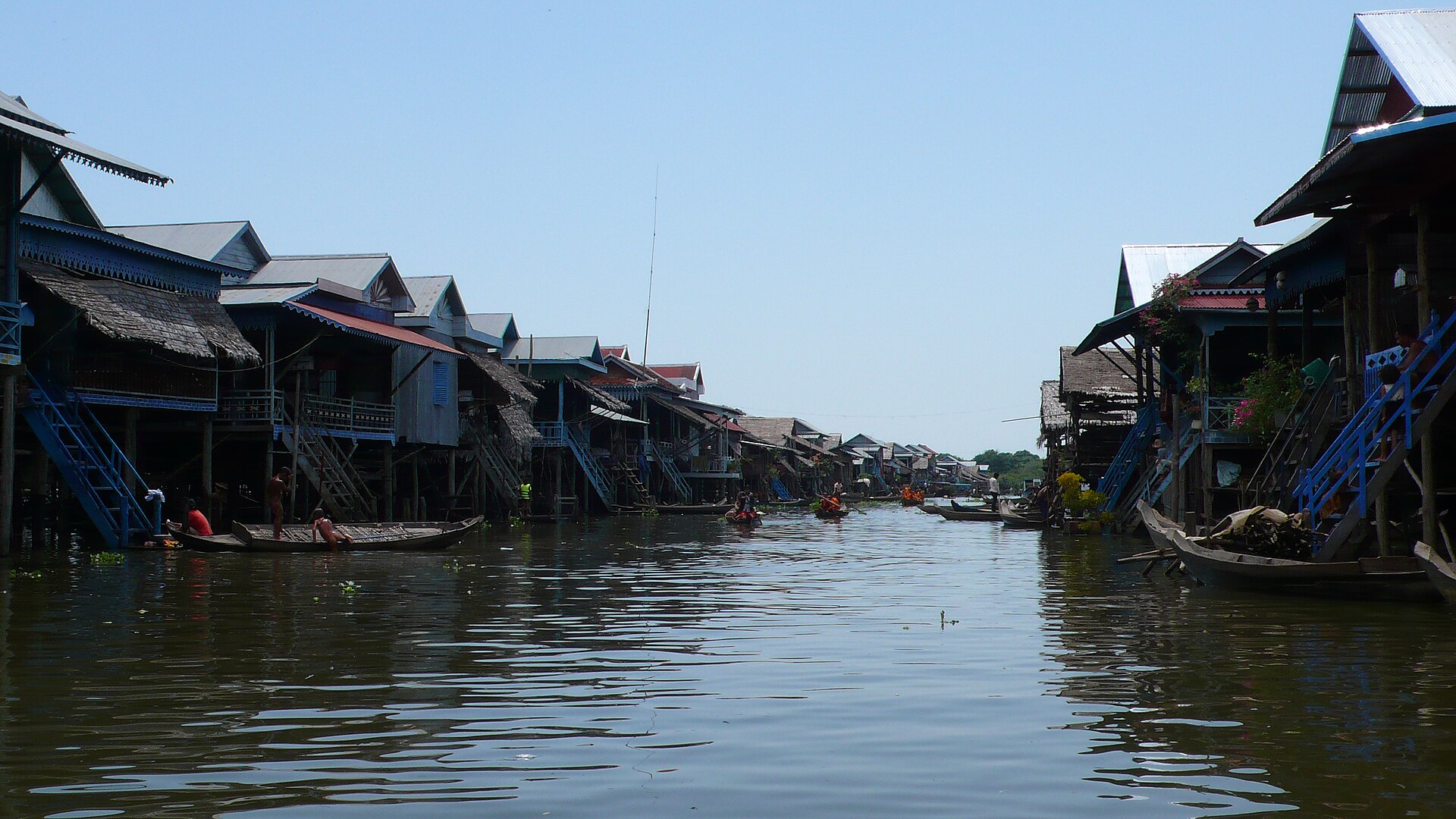
The misconception to drop first is the brochure phrase “floating village”. Chong Kneas, nearer Siem Reap, genuinely floats — houses on barrels and boats that rise with the water. Kampong Phluk's houses are fixed, and the stilts are the technology: tall enough that the annual flood, which can raise the lake by metres, reaches the floorboards but not through them. Everything follows from that one decision — the steep blue staircases you see in our photograph, the boats tied under houses, the school and pagoda built to the same pattern, and a street plan that works as a canal network for half the year.
The half-day trip from Siem Reap runs about 30km by road to a boat landing, then by motorboat down a channel into the village — the moment the channel opens out and the stilt houses line both banks is the photograph at the top of this page. In high water (roughly August to January) you stay on the water: the boat threads the village street, and local women offer a second, quieter ride in small paddle boats through the flooded forest, where the mangrove-like trees stand in the lake and the light comes through green. That paddle ride is an optional extra, paid separately — agree the price before you get in, in small cash (our money guide covers the notes to carry).
In the dry months the visit inverts. The lake retreats, the boat channel shortens or shifts, and the village stands exposed on its forest of poles — you see the full height of the stilts, the undersides of houses, and village life happening at ground level under the buildings. It is less postcard, more honest. Either season, hold the transaction to a simple standard: there is no single official ticket, fees are set locally and they change, so confirm the total — boat, entry, and what is optional — before you board. The travellers who leave Kampong Phluk annoyed are almost never annoyed at the village; they are annoyed at a price that was never stated plainly. The same lake system powers the slow boat to Phnom Penh in high water, covered in our Phnom Penh to Siem Reap route guide. The point of Kampong Phluk is that it is not a show: it is a working fishing commune that lets visitors pass through, and it reads best when you treat it that way.
Kampong Phluk is one village on a very large system. Our Tonle Sap lake guide explains the whole mechanism — the reversing river, the sixfold flood, and how the other villages compare — before you pick which one to visit.
Not quite — and that is what makes it interesting. Kampong Phluk's houses do not float; they stand on wooden stilts 6 to 9 metres tall on the Tonle Sap floodplain. In the wet season the lake rises until the water is near the floorboards and boats replace the streets. In the dry season the same houses tower over mud and channels.
By road then boat. The village is about 16km southeast of Siem Reap as the crow flies, roughly 30km by road — around 45 minutes by car or tuk-tuk to the boat landing, then a motorboat ride into the village. Most visitors go on a half-day trip from Siem Reap, booked through a hotel or a driver.
In the high-water months, roughly August to January, when the lake is up, the village is reached entirely by boat and the flooded forest can be paddled. From about March to May the water retreats, the stilts stand fully exposed and the boat ride shrinks — a striking sight, but a different one.
There is no single official ticket price — boat and entry fees are set locally and change, and the small paddle-boat ride through the flooded forest is usually an extra, charged separately. Confirm the full price before you board: what the boat costs, what entry costs, and what is optional. Anyone who will not break the price down is a reason to use a different boat.
Kampong Phluk is the balanced choice: a real stilt village with a flooded forest, close enough to Siem Reap for a half day. Chong Kneas is closer and truly floating, but it is the busiest and most tourist-worn of the three. Kampong Khleang, further east, is larger, quieter and the least visited — the pick if you have a full day and want the village with the fewest other visitors.
One short email a week with what actually changed on the ground — no fluff, no spam.
Free forever · One email a week · Unsubscribe anytime
Visa rule changes, the best travel deals we find, and new guides — once a week, no spam.
Free forever · Unsubscribe anytime
 Wander Cambodia