Last updated: November 17, 2026 · By Wander Cambodia
 By Sophea Khim · Host & Editor, Wander Cambodia
Most people picture Cambodia flat — rice fields, river plains, temple towers on the horizon. Bokor is the exception you can drive to. Preah Monivong Bokor National Park covers the high plateau of Phnom Bokor in the Elephant Mountains above Kampot, where the air turns cool, the forest turns to wind-bent scrub, and the ruins of a French hill station stand in the mist. The point is the contrast: in about an hour you climb from Kampot's riverside heat to a place where you may want a jacket.
In the early 1920s the French colonial administration built Bokor as an escape from the lowland climate — a small resort town at roughly 1,000 metres, with a grand hotel and casino, a post office, a church and houses for officials. Building it cost heavily in money and in workers' lives, a part of the story the romantic ruin photos skip. The station was abandoned and rebuilt more than once as Cambodia's wars moved through: first during the independence struggle, again in the Khmer Rouge years, when the plateau was a fought-over stronghold. What you walk through today is the layered result — colonial bones, wartime scars, and a modern resort development near the top that shares the mountain with the ruins.
The misconception is that Bokor is a ghost town frozen in time. It is not, and has not been for years. There is a working casino resort, new construction, a giant Buddha under construction on the ridge and plenty of domestic visitors on weekends. The old buildings are still the reason to come — just expect a living, changing mountain, not an abandoned film set.
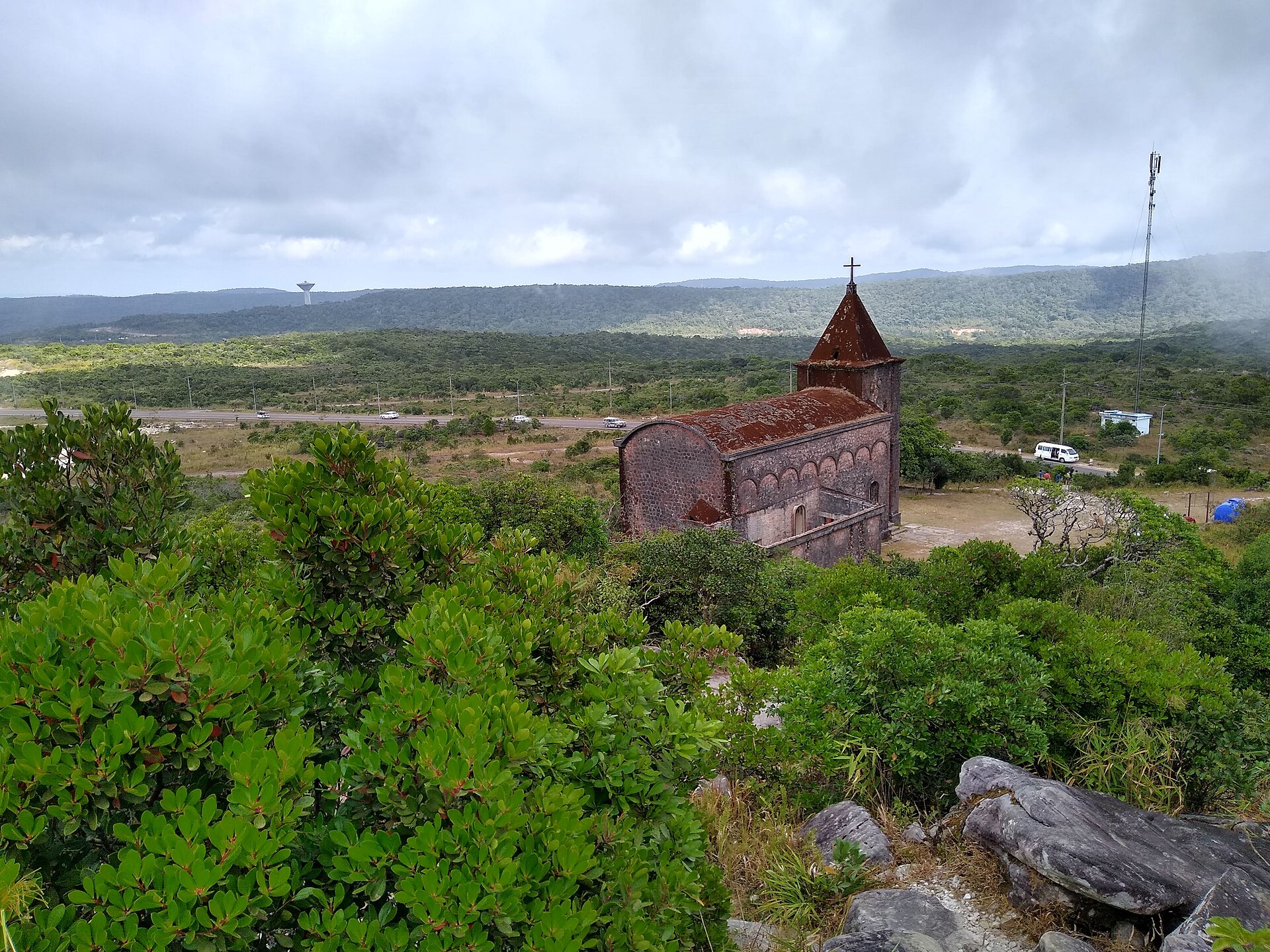
The plateau's most photographed building is the stone church, its tower and cross visible from across the top. It has stood through every abandonment, stained orange and black by decades of cloud. There is no ticket desk and no interior tour — you look, you walk around it, you take in how exposed this spot is when the mist rolls through. On a clear morning the view runs down to Kampot, the coast and, on the best days, Phu Quoc island in Vietnam.
Lower down the road sits the Black Palace, a dark-stone residence built in the 1930s for King Sihanouk's family, its name coming from the blackened timber and stone. It is smaller and quieter than the church, and most tour stops give it ten minutes. Give it a little longer: of all the Bokor ruins, it is the one that still reads as a house people actually lived in, which makes its emptiness land differently.
Popokvil is Bokor's waterfall, a two-tier drop in the forest a short drive from the hill station ruins. In the wet season it runs full and loud; in the dry months it can slow to a modest fall, so set expectations by the month — our best time to visit Cambodia guide lays out the season pattern. Either way the stop breaks up the ruin-hunting with actual national park: this plateau is protected forest, home to gibbons, hornbills and, on paper at least, much larger wildlife you will almost certainly not see from the road.
Drive the top slowly and stop at the viewpoints. The vegetation change is the quiet highlight — pines and stunted, wind-shaped trees replacing lowland jungle, with grassland that turns gold in the dry season. Photographers should come early: by mid-afternoon the cloud that gives Bokor its mood usually takes the views away entirely.
There is one road up, from the Kampot side, paved the whole way with long switchbacks. A tuk-tuk day hire handles it fine if slowly; a car is faster and warmer on a wet day; a rented motorbike suits confident riders only — the descent in rain and cloud is no place to learn mountain riding. You pass an entry checkpoint on the way up: fees and rules change, so carry small cash in riel and dollars (see money in Cambodia) and take the current situation from the gate, not from an old blog post — including this one.
Most visitors combine Bokor with the rest of a Kampot day: down by early afternoon for a pepper farm, then the riverfront for sunset. If you are moving along the coast, our Phnom Penh to Kampot route guide covers getting to the area in the first place. Stay overnight on the mountain only if the big resort is your thing — almost everyone sleeps in Kampot or Kep and day-trips up.
Bring a layer — the plateau can be 10 degrees cooler than Kampot, and wind and mist make it feel colder. Carry water and snacks; options at the top are limited and priced for a captive audience. The ruins are unfenced in places with drops and broken floors, so watch your step and keep children close. And go on a weekday if you can: Bokor is a beloved domestic weekend trip, and the church at 9am on a Tuesday is a different place from the church at noon on a Sunday.
Yes, if you are already in Kampot or Kep. The draw is the combination: a ruined French hill station — church, Black Palace, old casino shell — on a cool forested plateau about 1,000 metres up, with Popokvil waterfall and wide views to the coast. It is an easy half-day or full-day trip, not a standalone destination.
Bokor sits above Kampot on a single paved mountain road, roughly an hour's drive from town. Most visitors hire a tuk-tuk or car for the day, rent a motorbike if they are confident on mountain roads, or join a small-group tour from Kampot. There is an entry checkpoint partway up — carry small cash and confirm the current fee at the gate.
A stone Catholic church built during the French colonial period, when Bokor was a hill station where colonists escaped the lowland heat. It still stands near the top of the plateau, weather-stained and usually wrapped in cloud. It is a look-from-outside landmark rather than a museum — go for the building and the view, and respect it as a religious site.
The dry months, roughly November to April, give the clearest views from the plateau. In the wet season the top is often in thick cloud — atmospheric around the ruins, but the coastal view disappears. Mornings are usually clearer than afternoons in any month.
Yes — that is the standard Kampot day out. Do Bokor in the morning while the plateau is clearest, then come down to a pepper farm in the afternoon. Our guide to Kampot pepper farms covers how the farm visits work.
One short email a week with what actually changed on the ground — no fluff, no spam.
Free forever · One email a week · Unsubscribe anytime
Visa rule changes, the best travel deals we find, and new guides — once a week, no spam.
Free forever · Unsubscribe anytime
 Wander Cambodia