Last updated: November 11, 2026 · By Wander Cambodia
 By Sophea Khim · Host & Editor, Wander Cambodia
The eVisa and the visa on arrival are two ways of buying the same visa — online in advance at evisa.gov.kh ($30 tourist / $35 Ordinary), or at the counter when you land for the same prices in cash. The e-Arrival card is not a visa at all: it is the free, mandatory digital arrival form at arrival.gov.kh, completed within 7 days before an air arrival. If you fly in, you normally need a visa (either kind) plus the e-Arrival card.
Three similar names, three different things — and a small industry of reseller websites happy to blur them and charge you for the confusion. This page separates the three cleanly, in the order you actually deal with them. Our longer comparison, eVisa vs visa on arrival vs e-Arrival, works through which visa route suits which trip; this page is the direct answer.
Start with the one that is not a visa. The e-Arrival card (officially the Cambodia e-Arrival, or CeA) is the digital replacement for the paper arrival forms you once filled in on the plane. It has been mandatory for air arrivals since 1 July 2024, it is free, and it grants you nothing by itself — it simply tells Cambodian immigration who is arriving. You complete it at arrival.gov.kh or in the official app within 7 days before you fly and show the QR code on arrival. Our e-Arrival explainer walks through it screen by screen. Land and sea arrivals still use paper forms; the e-Arrival is an air-arrival system.
The eVisa is a real visa, bought before you travel from the official site, evisa.gov.kh — and only from there, because lookalike resellers charge $80 or more for the identical document. A tourist (Type T) eVisa costs $30; the Ordinary (Type E) eVisa costs $35. Both carry 3-month validity for a single entry and a 30-day stay, take around 3 business days to issue, and arrive as a PDF you print or keep on your phone. One limit matters: the eVisa is accepted at only five entry points — Techo International Airport (Phnom Penh), Siem Reap, Sihanoukville airport, Bavet (from Vietnam) and Tropaeng Kreal (from Laos). Our official eVisa walkthrough covers the application step by step.
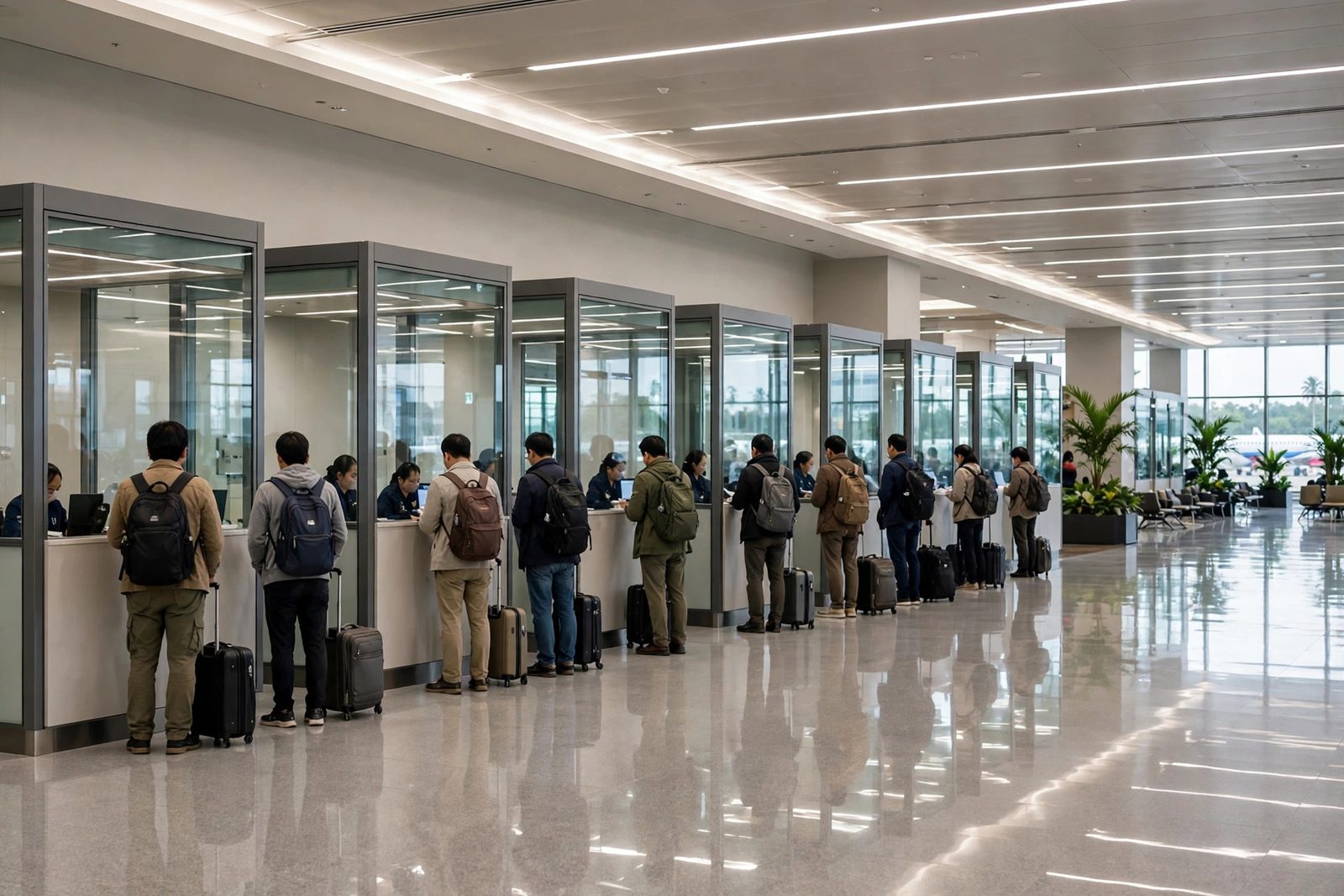
The visa on arrival is the same visa bought at the other end of the journey: a counter at the airport (or an open land border), a short form, a passport photo, and the same $30 / $35 in cash. It suits travellers who decided late or whose entry point does not take the eVisa. What it costs you is time in the arrivals queue and the small risk of a long line after a full flight — the walkthrough of what actually happens at the counter sets out the sequence honestly.
Flying in as a tourist: a tourist visa — eVisa in advance or on arrival — plus the e-Arrival card. Flying in to stay longer: an Ordinary (Type E) visa, again eVisa or on arrival, plus the e-Arrival card — the E is the entry that can be extended into EB, ER, EG or ES stays, which a tourist visa never can; see the wrong-visa trap before you book. Arriving by land or sea: a visa (on arrival at open borders, or an eVisa at Bavet or Tropaeng Kreal), and paper arrival forms instead of the e-Arrival card. Visa-exempt nationals: no visa, but the e-Arrival card still applies if you fly.
The expensive mistakes all come from mixing the three up: paying a reseller for the free arrival card, assuming the e-Arrival approval is a visa and landing without one, or buying a tourist eVisa for a trip that needs the Ordinary entry. Keep the sentence straight — visa = permission to stay; e-Arrival = the form that says you are coming — and none of those can happen to you.
Prices and rules checked November 2026: tourist eVisa $30, Ordinary eVisa $35 (fees were cut on 1 January 2025 — pages quoting $36/$42 are out of date). Always apply at evisa.gov.kh and arrival.gov.kh directly.
The eVisa and the visa on arrival are two ways of getting the same visa: the eVisa is bought online in advance at evisa.gov.kh ($30 tourist / $35 Ordinary), while the visa on arrival is bought at the counter when you land, for the same prices in cash. The e-Arrival card is not a visa at all — it is the free, mandatory digital arrival form (arrival.gov.kh) that air travellers complete within 7 days before arrival. Most air travellers need a visa (either kind) AND the e-Arrival card.
Yes, if you fly in. The visa gives you permission to enter and stay; the e-Arrival card is the arrival declaration that replaced the paper forms. One does not replace the other. Travellers who qualify for visa-free entry still complete the e-Arrival card.
Yes. The e-Arrival card at arrival.gov.kh (or the official app) is completely free. Any website charging a fee to 'process' your Cambodia arrival card is a reseller — the official form takes about 10 minutes and costs nothing.
One short email a week with what actually changed on the ground — no fluff, no spam.
Free forever · One email a week · Unsubscribe anytime
Visa rule changes, the best travel deals we find, and new guides — once a week, no spam.
Free forever · Unsubscribe anytime
 Wander Cambodia